
SPLIT BEAM Echosounders: Myths and Facts
SPLIT BEAM Echosounders:
Myths and Facts
\n
\n
The growth of Split Beam
In our work in countries with fisheries as diverse as the United States, Argentina, Peru and Spain, we have gathered experience about what can be achieved with SPLIT BEAM acoustic technology and also about the limits that exist today with this equipment. We have often learned on site about fish behavior and environmental conditions that make size measurement very difficult or even impossible.
Although SPLIT BEAM equipment is not a new technology —it has been on the market for several decades— it is new to many fishermen, especially on small and medium-sized artisanal vessels, who are gaining access to this equipment for the first time. It used to be out of their reach because of its high cost and operational complexity, and was therefore reserved almost exclusively for scientific use.
Equipment such as the SEAMAN DBF-4000-SB has helped democratize this technology, making it more accessible to all kinds of fishermen, while also creating the need to explain its possibilities and limitations to those who are not familiar with its use. Training fishermen is a key element in using this equipment successfully.
Below is a summary of the most frequent questions that arise when considering the purchase of a SPLIT BEAM acoustic tool to measure fish size.
What does it mean for an echosounder to be SPLIT BEAM?
All echosounders project a beam of sound, much like the light of a flashlight. If an object is caught in the center of the flashlight beam, it can be seen clearly, because that is where the power is concentrated. Towards the edges, the object looks more blurred. The same happens with sound. If a fish is caught in the center of the acoustic beam, it receives the full power and returns a strong echo, whereas the same fish at the edges of the beam will appear acoustically weaker. When converting sound into size, we might think these are different fish, one large and one small. SPLIT BEAM echosounders were created precisely to avoid this problem. “SPLIT BEAM” echosounders have a different transducer, or projector, from conventional ones: they have three or more beams instead of just one. The most common design has four beams. This makes it possible to position the fish within the sound beam and thus compensate for the difference that occurs when a fish is measured at the edge of the beam. To do this, SPLIT BEAM echosounders carry a special calibration that tells them how much the echo must be corrected depending on where the fish is located. An echosounder that is not SPLIT BEAM cannot apply this correction and will not measure accurately.
Can any type of fish be measured with a SPLIT BEAM echosounder?
\n
In general, all fish can be measured without any problem. However, there are limitations to measuring with sound underwater. Sound has a horizontal and a vertical resolution; in other words, a sound pulse occupies a given volume. Everything within that volume will return an echo. If there are several fish within that volume, the echo will be the sum of several fish and may therefore lead us to think it is a single large fish. This is why, when fish occur in very dense schools (many fish in a small space), measuring individual echoes with sound can be difficult, if not impossible. Fish without a swim bladder, such as some mackerel species, return a weaker echo than those that have one. The air inside their bodies produces an echo that is easier to pick up with acoustic waves. So the species itself can either help or complicate the measurement.
\n \n
Can I tell which fish it is using a SPLIT BEAM echosounder?
\n
Identifying fish species has been the holy grail of acoustics for several decades. Being able to know not only the size but also the species of an echo before catching it would truly make a decisive difference for fishermen. Given the current state of the technology, it is not easy to identify species with ultrasound alone. To identify a fish and know which species it belongs to, many variables must be taken into account, not just its acoustic strength, or Target Strength (TS). You have to consider its depth, the geographical location, the shape of the school, the size of the school, the time of year, the water temperature and salinity, etc. Each of these variables must be given a weight, and it is not always the same for all species. The human brain does much of this, since an experienced fisherman knows where to find the different species and what their echo looks like on the echosounder and the sonar. Using a single acoustic instrument, it is impossible to evaluate all this data in a few seconds and make a decision to show on a screen. So be wary of definitive solutions in this respect. There is very expensive and highly complex equipment that will bring you closer to the solution, but it will always have a degree of error or uncertainty; it will never be infallible.
\n \n
What does the bar chart shown on the screen of every SPLIT BEAM echosounder mean?
\n
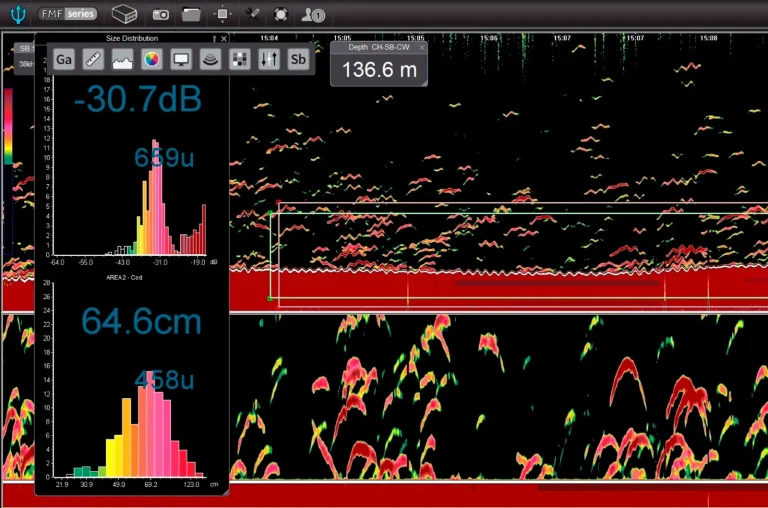
The bar chart is known as a SIZE HISTOGRAM, and it is a way of presenting information so that it can be read quickly and easily. Each bar represents a size, and its height tells us the weight of that size within the total measured. The average size is then shown as a number. However, it is very important to know how to read this chart in order to know whether the average size is valid. It is always better for the chart to have a single highest peak, because if it has several, the average is not reliable. As an aid to species identification, the DBF-4000 makes it possible to define areas of the chart in TS, each of which can be associated with one or two particular species. Depending on the fishing ground, some fishermen associate a certain bar color with a particular species. However, this is only valid in each particular case. The tool is very versatile and allows multiple interpretations that cannot always be generalized.
\n \n
Should I select a specific area or is it better to measure all the echoes on the screen?
\n
In some places, because of the way schools appear, as in Peru, fishermen set a vertical rectangular area on the right of the screen and leave the equipment fixed without changing that area. They then watch the average and check the histogram for very tall bars of small sizes, which could indicate the presence of juveniles or munida, a species of squat lobster that accompanies anchoveta. In other places, such as northern Spain, they prefer to analyze each school by measuring different parts to see the results. Measuring very small areas can be misleading, while measuring very large areas can bring into the measurement species that are not our target because they are at depths outside our working range. You always have to pay attention to the target species and their behavior.
\n \n
Can I trust the size data the equipment is giving me?
Acoustic size-measurement equipment works statistically. The software filters out echoes that cannot be measured, and only those that have passed very strict rejection criteria are shown. So, as with any statistic,
the larger the sample of well-measured fish, the better the result
. In general, keep in mind that
very dense schools cannot be measured well at their center
, but they can at their edges. Finally, remember that if the shape of the histogram shows
a single peak
, the
average is more realistic
. All of these are quick visual indicators of a more reliable measurement. You should not always rely on the average size, only when the conditions mentioned above are met. The equipment can, however, be adjusted if deviations are detected, in order to get closer to the actual size. To do this, you need to keep a record of catches and compare them with the measurements to spot a trend and make an adjustment.
Are SPLIT BEAM echosounders expensive and complex to maintain?
\n
In the past, SPLIT BEAM equipment used to be much more expensive than it is now, and difficult to operate and maintain. Today, advances in computing and electronics, as well as new piezoelectric materials for manufacturing transducers, put this equipment within reach of almost any commercial fisherman. It requires minimal training: it is not the kind of equipment you simply switch on and start using, since there is a learning curve, but it is well within the reach of anyone who uses an average personal computer. Then, of course, it is personal skill, observation and intuition that ultimately make the difference. It is very important, however, to know how the equipment works and what its limitations are, so as not to ask it for impossible results or end up using only part of its real potential.
\n \n
Does installing SPLIT BEAM equipment make a difference in fishing?
\n
When properly installed and configured, and used well by a fisherman who understands its possibilities and limitations, it undoubtedly makes a great difference in fishing efficiency and in reducing bycatch. Its value for money, compared with the benefits it provides, clearly makes it a worthwhile purchase. In light of new regulations aimed at the long-term sustainability of fisheries worldwide, the adoption of these and other technologies for acoustic size measurement will be a growing trend.
\n \n
Will acoustic equipment improve size measurement?
New pulse compression or “CHIRP” technologies have already helped improve the performance of measurement equipment, but they are still far from solving the problem once and for all. MULTIBEAM equipment with 3D scanning and CHIRP pulses helps even more in trying to measure dense schools, but it always comes up against the limitations of sound. The more complex the equipment, the more expensive and difficult it is to operate, putting it beyond the reach of fishermen and reserving it for scientific use. Nevertheless, hydroacoustics is a field of ongoing research with constant progress. Our challenge as manufacturers is to turn these advances into useful tools for commercial fishing.
SPLIT BEAM Echosounders:
Myths and Facts
\n
\n
The growth of Split Beam
In our work in countries with fisheries as diverse as the United States, Argentina, Peru and Spain, we have gathered experience about what can be achieved with SPLIT BEAM acoustic technology and also about the limits that exist today with this equipment. We have often learned on site about fish behavior and environmental conditions that make size measurement very difficult or even impossible.
Although SPLIT BEAM equipment is not a new technology —it has been on the market for several decades— it is new to many fishermen, especially on small and medium-sized artisanal vessels, who are gaining access to this equipment for the first time. It used to be out of their reach because of its high cost and operational complexity, and was therefore reserved almost exclusively for scientific use.
Equipment such as the SEAMAN DBF-4000-SB has helped democratize this technology, making it more accessible to all kinds of fishermen, while also creating the need to explain its possibilities and limitations to those who are not familiar with its use. Training fishermen is a key element in using this equipment successfully.
Below is a summary of the most frequent questions that arise when considering the purchase of a SPLIT BEAM acoustic tool to measure fish size.
What does it mean for an echosounder to be SPLIT BEAM?
All echosounders project a beam of sound, much like the light of a flashlight. If an object is caught in the center of the flashlight beam, it can be seen clearly, because that is where the power is concentrated. Towards the edges, the object looks more blurred. The same happens with sound. If a fish is caught in the center of the acoustic beam, it receives the full power and returns a strong echo, whereas the same fish at the edges of the beam will appear acoustically weaker. When converting sound into size, we might think these are different fish, one large and one small. SPLIT BEAM echosounders were created precisely to avoid this problem. “SPLIT BEAM” echosounders have a different transducer, or projector, from conventional ones: they have three or more beams instead of just one. The most common design has four beams. This makes it possible to position the fish within the sound beam and thus compensate for the difference that occurs when a fish is measured at the edge of the beam. To do this, SPLIT BEAM echosounders carry a special calibration that tells them how much the echo must be corrected depending on where the fish is located. An echosounder that is not SPLIT BEAM cannot apply this correction and will not measure accurately.
Can any type of fish be measured with a SPLIT BEAM echosounder?
\n
In general, all fish can be measured without any problem. However, there are limitations to measuring with sound underwater. Sound has a horizontal and a vertical resolution; in other words, a sound pulse occupies a given volume. Everything within that volume will return an echo. If there are several fish within that volume, the echo will be the sum of several fish and may therefore lead us to think it is a single large fish. This is why, when fish occur in very dense schools (many fish in a small space), measuring individual echoes with sound can be difficult, if not impossible. Fish without a swim bladder, such as some mackerel species, return a weaker echo than those that have one. The air inside their bodies produces an echo that is easier to pick up with acoustic waves. So the species itself can either help or complicate the measurement.
\n \n
Can I tell which fish it is using a SPLIT BEAM echosounder?
\n
Identifying fish species has been the holy grail of acoustics for several decades. Being able to know not only the size but also the species of an echo before catching it would truly make a decisive difference for fishermen. Given the current state of the technology, it is not easy to identify species with ultrasound alone. To identify a fish and know which species it belongs to, many variables must be taken into account, not just its acoustic strength, or Target Strength (TS). You have to consider its depth, the geographical location, the shape of the school, the size of the school, the time of year, the water temperature and salinity, etc. Each of these variables must be given a weight, and it is not always the same for all species. The human brain does much of this, since an experienced fisherman knows where to find the different species and what their echo looks like on the echosounder and the sonar. Using a single acoustic instrument, it is impossible to evaluate all this data in a few seconds and make a decision to show on a screen. So be wary of definitive solutions in this respect. There is very expensive and highly complex equipment that will bring you closer to the solution, but it will always have a degree of error or uncertainty; it will never be infallible.
\n \n
What does the bar chart shown on the screen of every SPLIT BEAM echosounder mean?
\n
The bar chart is known as a SIZE HISTOGRAM, and it is a way of presenting information so that it can be read quickly and easily. Each bar represents a size, and its height tells us the weight of that size within the total measured. The average size is then shown as a number. However, it is very important to know how to read this chart in order to know whether the average size is valid. It is always better for the chart to have a single highest peak, because if it has several, the average is not reliable. As an aid to species identification, the DBF-4000 makes it possible to define areas of the chart in TS, each of which can be associated with one or two particular species. Depending on the fishing ground, some fishermen associate a certain bar color with a particular species. However, this is only valid in each particular case. The tool is very versatile and allows multiple interpretations that cannot always be generalized.
\n \n
Should I select a specific area or is it better to measure all the echoes on the screen?
\n
In some places, because of the way schools appear, as in Peru, fishermen set a vertical rectangular area on the right of the screen and leave the equipment fixed without changing that area. They then watch the average and check the histogram for very tall bars of small sizes, which could indicate the presence of juveniles or munida, a species of squat lobster that accompanies anchoveta. In other places, such as northern Spain, they prefer to analyze each school by measuring different parts to see the results. Measuring very small areas can be misleading, while measuring very large areas can bring into the measurement species that are not our target because they are at depths outside our working range. You always have to pay attention to the target species and their behavior.
\n
Can I trust the size data the equipment is giving me?
Acoustic size-measurement equipment works statistically. The software filters out echoes that cannot be measured, and only those that have passed very strict rejection criteria are shown. So, as with any statistic,
the larger the sample of well-measured fish, the better the result
. In general, keep in mind that
very dense schools cannot be measured well at their center
, but they can at their edges. Finally, remember that if the shape of the histogram shows
a single peak
, the
average is more realistic
. All of these are quick visual indicators of a more reliable measurement. You should not always rely on the average size, only when the conditions mentioned above are met. The equipment can, however, be adjusted if deviations are detected, in order to get closer to the actual size. To do this, you need to keep a record of catches and compare them with the measurements to spot a trend and make an adjustment.
Are SPLIT BEAM echosounders expensive and complex to maintain?
\n
In the past, SPLIT BEAM equipment used to be much more expensive than it is now, and difficult to operate and maintain. Today, advances in computing and electronics, as well as new piezoelectric materials for manufacturing transducers, put this equipment within reach of almost any commercial fisherman. It requires minimal training: it is not the kind of equipment you simply switch on and start using, since there is a learning curve, but it is well within the reach of anyone who uses an average personal computer. Then, of course, it is personal skill, observation and intuition that ultimately make the difference. It is very important, however, to know how the equipment works and what its limitations are, so as not to ask it for impossible results or end up using only part of its real potential.
\n \n
Does installing SPLIT BEAM equipment make a difference in fishing?
\n
When properly installed and configured, and used well by a fisherman who understands its possibilities and limitations, it undoubtedly makes a great difference in fishing efficiency and in reducing bycatch. Its value for money, compared with the benefits it provides, clearly makes it a worthwhile purchase. In light of new regulations aimed at the long-term sustainability of fisheries worldwide, the adoption of these and other technologies for acoustic size measurement will be a growing trend.
\n \n
Will acoustic equipment improve size measurement?
New pulse compression or “CHIRP” technologies have already helped improve the performance of measurement equipment, but they are still far from solving the problem once and for all. MULTIBEAM equipment with 3D scanning and CHIRP pulses helps even more in trying to measure dense schools, but it always comes up against the limitations of sound. The more complex the equipment, the more expensive and difficult it is to operate, putting it beyond the reach of fishermen and reserving it for scientific use. Nevertheless, hydroacoustics is a field of ongoing research with constant progress. Our challenge as manufacturers is to turn these advances into useful tools for commercial fishing.