Noise in the Echosounder – Part 2
Noise in echosounders with FM or CHIRP pulse: Part 2For fishing technicians and captains who use echosounders, noise management is crucial, since noise can compete directly with the signal and affect the accuracy of these instruments. CHIRP technology, which uses frequency-modulated (FM) pulses, has improved detection in noisy environments by offering higher resolution and a better signal-to-noise ratio. However, although this technology overcomes many limitations of CW echosounders, it also presents challenges such as side lobes near the seabed. This article examines how FM or CHIRP pulses improve noise mitigation compared with CW echosounders, highlighting their advantages and presenting possible drawbacks. The importance of FM or CHIRP pulses when it comes to noiseCHIRP technology has overcome the limitations of continuous wave (CW) echosounders in noise management. By emitting a pulse that covers a wide range of frequencies, CHIRP echosounders achieve higher resolution and accuracy in detecting underwater signals, significantly improving the signal-to-noise ratio (SNR) and offering clearer, more detailed images, even in noisy environments. A conventional echosounder uses a continuous wave sound pulse, or CW. In a CW pulse echosounder, noise is a critical problem to solve, because it directly and decisively affects the signal; in other words, it competes with the signal in level. If an echosounder emits a pulse and receives an echo with the same strength as the noise, or weaker, the noise may win over the useful signal. To use our CW echosounder correctly, noise must be kept as low as possible, always below the minimum level of the signal we want to detect. This situation defines what is commonly known as the sensitivity of the equipment. In CW echosounders we must increase the power so that our signal prevails over the noise, that is, to improve our signal-to-noise ratio (SNR).
In frequency-modulated or FM pulse echosounders, commonly known as CHIRP echosounders (Compressed High Intensity Radar Pulse), a pulse is emitted that carries information across a set of several frequencies. To process this information, it goes through a comparison filter or “Matching Filter”. To process an echo, a “seed” pulse is compared with the received echo. The “seed” represents the pulse transmitted into the water, which is used to search for and recover the received echo. The echo can be successfully recovered even when the noise exceeds it in level, because we know in advance the pulse we sent and therefore what to look for and what to discard in what we receive. For the user, much of the noise disappears from the screen, generally giving a much cleaner image than that obtained with a continuous wave (CW) pulse echosounder.This is mainly due to the following factors:● Higher resolution and detail: CHIRP technology makes the echosounder emit pulses over a range of frequencies, compared with continuous pulse echosounders. This allows better resolution and detail in the image of the received echoes, making it easier to identify the insonified objects or fish. They can discriminate between different types of targets more accurately. This is useful to distinguish between fish, aquatic vegetation, sediments and other elements on the seabed.● Greater range and depth: CHIRP echosounders usually have greater range and penetration than continuous pulse echosounders. This allows more effective exploration of deep waters and the detection of targets at greater distances.● Less interference: CHIRP technology is less susceptible to external interference and noise, resulting in a clearer and more accurate image even under high electromagnetic interference.Effectiveness of the CHIRP pulse in removing noise.Below we analyze the ability of CHIRP pulse echosounders to remove noise, highlighting their effectiveness compared with continuous wave (CW) technologies. We examine how a CHIRP echosounder can mitigate “additive noise”, which comes from external sources, significantly improving the signal-to-noise ratio (SNR). Depending on where it originates, noise can be considered “additive noise” or “reverberation”. The latter is the acoustic signal received from the echo produced by objects floating in the water, such as plankton or algae, while “additive noise” covers all the other noises we have analyzed, which have various causes but are not caused by our own equipment’s transmission. Reverberation affects both CW and FM or CHIRP echosounders equally, since these are echoes that the comparison filter cannot remove. Additive noise, on the other hand, can be successfully removed by the comparison filter, since it is nothing that can be matched with the transmitted seed.
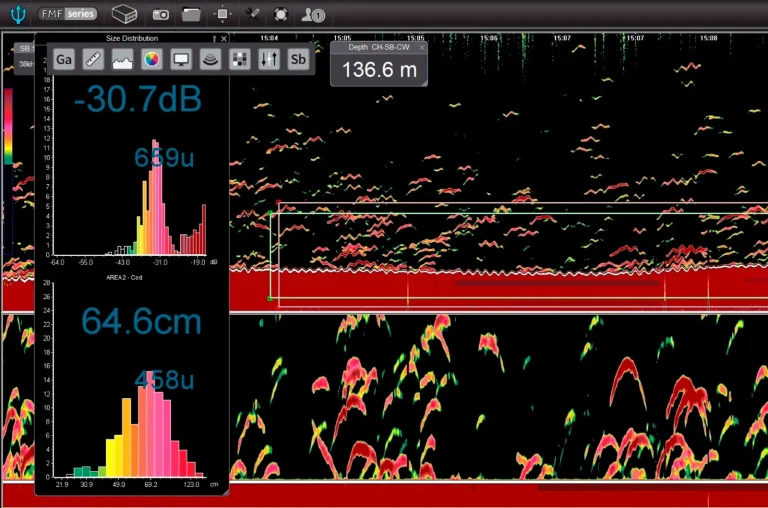
In tests comparing both technologies, the improvement in signal-to-noise ratio with an FM pulse over a CW pulse is equivalent to increasing the power of the latter 50 times, something that is normally very difficult, if not impossible, to achieve in practice.The greatest advantage of the FM or CHIRP pulse is that the duration of the ultrasound pulse can be increased without sacrificing the vertical resolution of the system. With longer pulses, the total energy transmitted into the water is exponentially greater than with a CW pulse. In this way, the Signal-to-Noise Ratio (SNR) is also significantly improved, without the adverse effects of losing resolution.Adverse effects of the FM or CHIRP pulse in relation to noise.This third and final section addresses the disadvantages of the CHIRP pulse when detecting fish near the seabed, highlighting an adverse effect called side lobes. We explore methods to mitigate this problem, such as window filters, and their possible consequences on resolution. The FM or CHIRP pulse is always recommended in noisy environments, although it has some disadvantages, especially when trying to detect fish close to the bottom. This is due to an adverse effect known as side lobes. Side lobes are an unwanted by-product of using the comparison or matching filter, and they are especially critical near the bottom, because the bottom generally appears as a very strong echo compared with the echoes produced by fish. All echoes can produce side lobes with an FM pulse, but the bottom will produce a very noticeable effect on the echosounder screen.For the user, the side lobe produced by the bottom will look like a band of noise covering the whole area above the bottom. Given the level of these side lobes, it is impossible to filter them without also removing useful echoes of the same strength in the process.To minimize side lobes, the Seaman FMF echosounder has different filters known as “window filters”. These are mathematical processes applied to both transmission and reception. However, although these filters mitigate the effect of side lobes over the bottom, they do not eliminate them completely, and the improvements they bring come with unwanted effects, such as a loss of vertical resolution. This means we may lose the ability to detect echoes very close to the bottom using a CHIRP pulse, unless those echoes exceed a certain signal level, that is, unless they are strong enough to get past the filter applied.
In conclusion, the CHIRP echosounder is a better option for mitigating noise than a continuous pulse echosounder because of its ability to spread the signal energy across a wider range of frequencies, resulting in better target discrimination and a higher signal-to-noise ratio. This makes it more effective in variable and noisy underwater environments.
However, it is not better in every respect, for example if we consider the side lobe over the seabed as an unwanted effect. What matters is always knowing all the available options in order to get the most out of each particular fishing gear.